
You don’t have to be at the gym all day, or follow super strict diets, to lose weight. Instead, it’s best to create a training schedule that includes strength training, cardiovascular exercise, daily activity, proper nutrition, and rest. These routines can help you finally build your fitness and work up to a healthier body weight if you do them together.
When you’re beginning, one of the main difficulties you’re going to have is knowing what to do each day. Do you want to do some exercise with weights? Do cardio? Walk? Rest? But just how much exercise is enough?
This 4 week weight loss workout plan provides you with an easy plan to follow, and as your fitness level improves, the workouts become more difficult. If you’re exercising at home or at the gym the idea is not to get a big result overnight but to get it consistent.
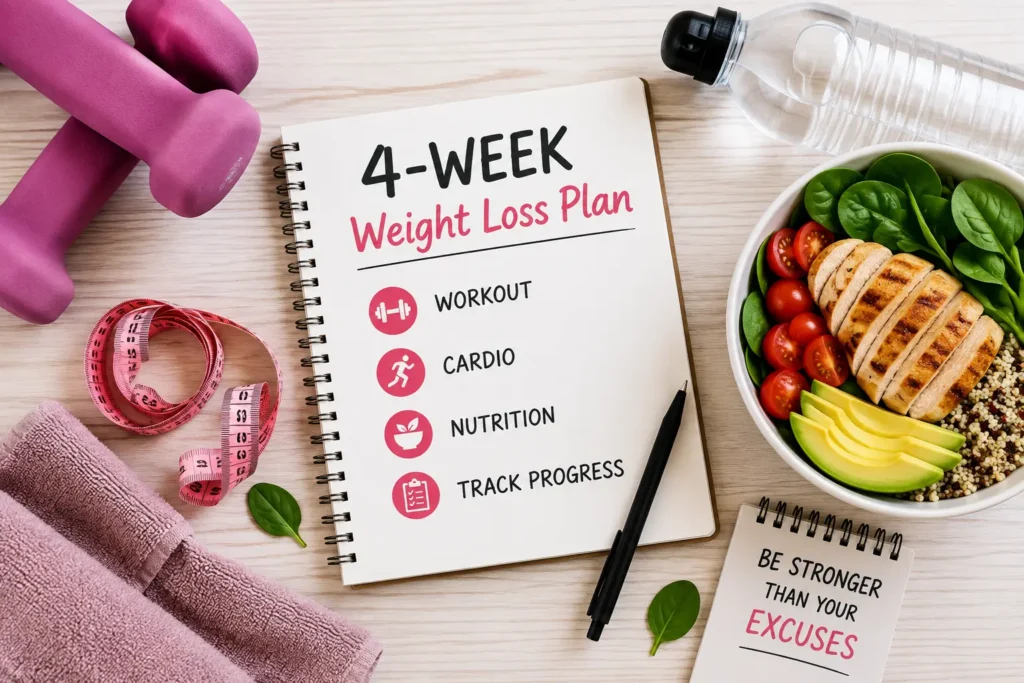
How This 4-Week Weight Loss Workout Plan Works
The plan consists of three strength training sessions, two cardio sessions, active recovery session, and a rest day per week.
You don’t need to make every workout extremely intense. In fact, it’s possible you can start too hard and become exhausted, too sore, or less likely to follow through with the workout.
Rather, each week allows the body to acclimate itself to the changes before beginning with more.
Consider fitness level, time, equipment and goals before beginning. Knowing how to structure exercises into a routine will help you make decisions about training frequency, exercise selection and weekly scheduling when you don’t know what to do.
Week 1: Build Your Foundation

The first week is about forming a habit and mastering the correct exercise technique.
Freaking out about heavy weights or doing as many reps as you can isn’t a concern. Prioritize slow-moving and proper movements.
Monday — Full-Body Strength
- Push ups: 3 sets × 10 reps
- Incline push-ups: 3 × 8–10
- Glute bridges: 3 × 12
- Dumbbell row and/or resistance band rows: 3 sets of 10 reps each
- Plank: 3 × 20–30 seconds
Tuesday — Strength Training or Cross Training
Walk to your heart’s content for 20-30 minutes.Walk, play, cycle or swim until you’re done.
Wednesday — Full-Body Strength
Repeat Monday’s workout. If the exercises seem easier, then work on the technique first, don’t immediately start increasing the weight.
Thursday — Active Recovery
Do gentle mobility and stretching for 10-15 minutes or take a quick walk.
Friday — Full-Body Strength
Complete the strength session again and consider making controlled and consistent repetitions.
Saturday — Cardio
Complete moderate intensity cardiovascular exercise for 25-30 minutes.
Sunday — Rest
Take a complete rest day and allow your body to recover.
If you have been inactive for a while, don’t assume that you will be able to start exercising at your old level. With regular training, your fitness can be restored even after a few weeks off the gym, and knowing how long it takes to rebuild muscle after a gym break can provide a more realistic expectation.
Week 2: Increase Your Activity

The idea is that by the second week, you’ll be trying to do a little more each day but not too much more.
A few reps to some exercises, walk a bit longer or add a little more intensity to the cardio.
Your schedule can remain:
- Monday: Strength
- Tuesday: Cardio
- Wednesday: Strength
- Thursday: Active recovery
- Friday: Strength
- Saturday: Cardio
- Sunday: Rest
Don’t assume that if you don’t have an hour to spare, then your exercise is not worth doing. If you’re pressed for time, you can find an efficient way to mix strength and cardio in a single 30-minute workout plan.
Week 3: Increase the difficulty of workouts.

Your body might be getting used to the workouts by week 3. This is why it is important to have a step-by-step approach.
There are plenty of ways to make exercises more difficult. Try to add more repetitions, add resistance, decrease the tempo, or increase to a more difficult variation.
For example:
- Bodyweight squat → pause squat
- Incline push-up → standard push-up
- Glute bridge → single-leg glute bridge
- Regular plank → longer plank hold
You don’t have to replace all of the exercises immediately. Select one or two movements to work through, but stick to the rest of your workout.
When bodyweight exercises start to get simple, How to Make Bodyweight Workouts Harder: 7 Ways to Progress offers advice on how to make workouts more challenging, without just overdoing the reps.
Week 4: Build Strength and Consistency

The fourth week wraps it all up.
Maintain 3 strength sessions and 2 cardio sessions, but keep in mind quality and not quantity.
Once you’re able to perform the desired number of reps with proper form, add a bit of weight or do a more challenging type of exercise.
The idea of week four is not to go to the extreme. It’s to leave the program feeling empowered, stronger and more confident for your next training level.
Don’t Forget Your Daily Movement
Energy is used in your body not only during a workout.
Any activity that involves walking, climbing stairs, standing often, doing household tasks, and taking small movement breaks throughout the day will count towards your overall activity level.
It’s not an obsession to try to get a certain number of steps in. Instead, find the simple ways to get moving more regularly.
Making any change can make an active lifestyle more sustainable in the long term.

Strength Training Matters During Weight Loss
While people may focus mainly on cardio when they’re looking to lose weight, strength training should play a crucial role in their workout.
Resistance training can build and maintain muscle, increase strength, and enhance physical function. Learning the basics can help make lifting less intimidating for women who are new to it. Strength Training for Women is a great book for learning about exercises, resistance training and getting started with weight building.
Also, keep in mind that gaining strength does not equate to gaining size. Strength training can be tailored to the individual’s objectives, fitness level and training style.
How Many Cardio Exercises Should You Do?
Cardio can help you be more active and boost your cardio fitness, but there is no such thing as too much.
Depending on your fitness and preference, brisk walking, cycling, swimming, jogging, dancing and other activities can be done.
The aim is to discover how much cardio you really can manage which is beneficial for weight loss while not hindering recovery or strength training.
It’s not necessary to think that you have to work out an hour a day, seven days a week to get results. Can Just One Gym Session a Week Help You Lose Weight? examines how small amounts of activity can be better than none, and the importance of being consistent.

What Should You Eat During These Four Weeks?
Weight loss and management is not just about exercise! The whole diet is also very important.
Don’t just focus on extreme diets, but use healthy food choices as the foundation of your meal and include enough calories for your body to function.
Good options include:
- Eggs
- Greek yogurt
- Chicken
- Fish
- Beans and lentils
- Vegetables
- Fruits
- Oats
- Whole grains
- Nuts and seeds
Protein is particularly beneficial when you are trying to lose weight as it helps to preserve the muscle tissue and helps to regenerate it. When you’re contemplating how “when” protein is important, the best time to take protein can give you an idea of how protein intake relates to exercise and food.
An enjoyable eating plan also involves fiber. Fiber-rich foods are beneficial for digestive health and can help promote a feeling of fullness. However, protein and fiber play different roles – it is not a question of which is better or which is to be preferred. Fiber vs. Protein describes the distinction between fiber and protein, and how they can be incorporated into a healthy diet.

A Simple Day of Eating
With a weight loss program, there is no need for complicated recipes to adhere to a healthy diet.
A simple day could consist of:
- Snacks: A sandwich with whole-grain bread and Greek yogurt, berries and chia seeds.
- Lunch: Grilled chicken and vegetables and brown rice.
- Snack: Salad, hummus or another dip and fruit.
- Dinner: Fish or beans or lean meat with vegetables and whole grain carbohydrate.
Adjust portions to meet your own energy needs, appetite, activity and objectives.
Warm Up Before Training
The right amount of preparation time can make it easier to enter into your workout and get your body moving.
Before strength training, perform 5-10 minutes of light exercises of the following type:
- Brisk walking
- Marching in place
- Arm circles
- Hip circles
- Bodyweight squats
- Gentle lunges
Then do easier versions of your first exercise before starting your working sets.

Give Your Body Time to Recover
Greater exercise doesn’t always make for a better outcome.
Your body must recover to adjust to training. Incorporate sleep, water, a well-balanced diet and rest days into the plan, not as an optional extra.
Reduce intensity and increase recovery if you are always tired, noticeably sore or unable to do exercises that you used to be able to do.
Instead of basing your fitness practice on fitness myths or extreme methods, you can discover more health-oriented and sustainable fitness strategies with the aid of Science-Backed Fitness Tips.
What If You Want to Lose Belly Fat?
One of the common objectives while losing weight is to lose fat from the belly area. But, you cannot decide where the fat in your body will melt off first.
The proper diet, exercise and strength training can help to burn off body fat with time.
If it’s belly fat you’re especially worried about, then [How to Lose Belly Fat] outlines what you can reasonably hope to accomplish and what habits you should adopt to help you lose fat overall.
What If You Miss a Workout?
But it doesn’t matter if you miss a session, it will not ruin all your progress.
Don’t make up for it with a very long exercise session the next day. When possible, resume your normal routine.
The same applies if you have a busy week. A solid strategy which you can stick with is better than an ideal plan which you can only follow for a few days.
What If the Exercises Are Too Difficult?
All of the following exercises can be adapted to the person’s level of fitness.
For example:
- Push-up: Wall push up → Incline push up → Knee push up → standard push up.
- Squat: Assisted squat → bodyweight squat → pause squat → weighted squat
- Tilt exercise: Elevated plank progression to standard plank, to longer plank hold, to advanced variation.
Select the one that keeps you in good form while providing a challenge at the same time.
Common Weight-Loss Workout Mistakes
Don’t make these mistakes during a 4 week program:
- It’s better to start too slowly than too quickly.
- Waking up every day and performing heavy exercise.
- Ignoring strength training
- Skipping rest days
- Following an extremely restrictive diet
- Varying your exercise routine every few days
- Actively using just the number on the scale
- Overlooking the sacrifices required for more reps
It doesn’t take a big change for progress to be significant. When you regularly finish your exercises, when you are getting stronger, when you are gaining endurance, when you are forming new healthy habits, you know that your workout routine is working.
How to Track Your Progress
There is more to a measurement than weight.
For the next four weeks, try keeping track of:
- Body weight
- Waist measurement
- Workout completion
- Cardio sessions
- Strength improvements
- Energy levels
- Progress photos
Ideally take measurements with the same conditions for consistency of comparisons.
Track Your 4-Week Progress
Record your workouts, cardio, weight, waist measurement, and weekly notes. Track your progress throughout the four-week program.
Week 1
Week 2
Week 3
Week 4
Your 4-Week Progress
Your progress is saved locally in your browser and is not sent to our website.
Focus on consistency and overall changes rather than expecting dramatic results within a few days.
What Should You Do After Week 4?
The four weeks are not the end of your progress, they’re the beginning.
If the exercise program is still challenging, then keep doing the same exercises and slowly add more reps or weight. When the exercises are easy, add more resistance or progress to a more challenging workout.
If you’ve taken the time to read through How to Build Your Own Workout Routine you can go back to it and apply the knowledge you gained over the past four weeks to design a workout plan that’s more suited to your current fitness level.
The most crucial factor is to not perpetually look for a new exercise regimen. Allow adequate time for adaptation, monitor progress and adjust as needed.
Conclusion
Don’t make a “difficult” or “extreme” weight loss routine. The secret is to develop a program that includes strength, cardio, activity, healthy eating and sufficient recovery.
This is a 4 week program that will provide you with a solid plan to begin with but will leave you some freedom to modify the exercises or intensity based on your fitness level. Do not aim for a dramatic change in your fitness level, but work on being more consistent, stronger, and healthier.
After the four weeks, make a determination about your progress and what you should do next. It’s possible you’re in a position to get more resistance, more time with the equipment, tougher exercises, or a different form of training objective.
The ideal workout program isn’t the one that guarantees immediate outcomes, it’s the one you can stick to, enhance and sustain.
Frequently Asked Questions
Is it possible to shed pounds with a 4 week training course?
While a structured workout programme can help with weight loss, there are various factors that influence the outcome of weight loss, such as nutrition, activity level, quality of sleep, adherence and individual differences. Fortunately, there aren’t specific weight loss amounts that everyone will see for four weeks.
Do 30 minutes of exercise provide sufficient time for weight loss?
Yes. When you’re consistent, a focused 30-minute workout can be an effective way to build strength and increase physical activity.
How many days of the week do you need to get some exercise to shed pounds?
If you’re a beginner, you can begin with a few small sessions of exercise a week that include strength training, cardio, and recovery. Your plan will depend on your fitness, availability, and how quickly you can recover.
Should I do cardio before or after strength training?
If you’re focused mainly on building strength, you might want to do strength training first, so you can have more energy and attention to devote to the task. Light cardio may also be employed as a warm up prior to resistance training.
If after 4 weeks I don’t lose weight?
Don’t assume that the plan isn’t working. Check nutrition, activity, sleep, consistency, other progress indicators (waist, strength, etc.). Weight fluctuations can also happen on a short term basis due to normal fluctuations.